AI integration in airline revenue management represents a multi-billion-dollar opportunity: up to 1% of profitability today (approximately $30 billion across the industry) and up to 5% within five years, translating to over $100 billion by 2030. Eighty-five percent of hotels plan to increase their investment in AI-driven pricing technologies over the next two years. The global hotel revenue management software market is expected to reach $2.8 billion by 2027.
The numbers are large, but the strategic insight is more important than the market size: the firms generating the highest returns from AI revenue management are not simply doing dynamic pricing faster. They are expanding the scope of yield management beyond room rates and seat prices to encompass total guest spend across every revenue-generating touchpoint.
Beyond Dynamic Pricing
Traditional yield management in travel and hospitality optimises a single variable: the price of a perishable asset (a hotel room, an airline seat, a rental car for a specific date). The AI calculates demand probability, competitive positioning, and time-to-departure, and adjusts the price to maximise revenue. This is well-understood, widely deployed, and increasingly commoditised. Every major hotel chain and airline uses some form of AI-assisted dynamic pricing. When everyone has the same tool, the tool stops being a competitive advantage.
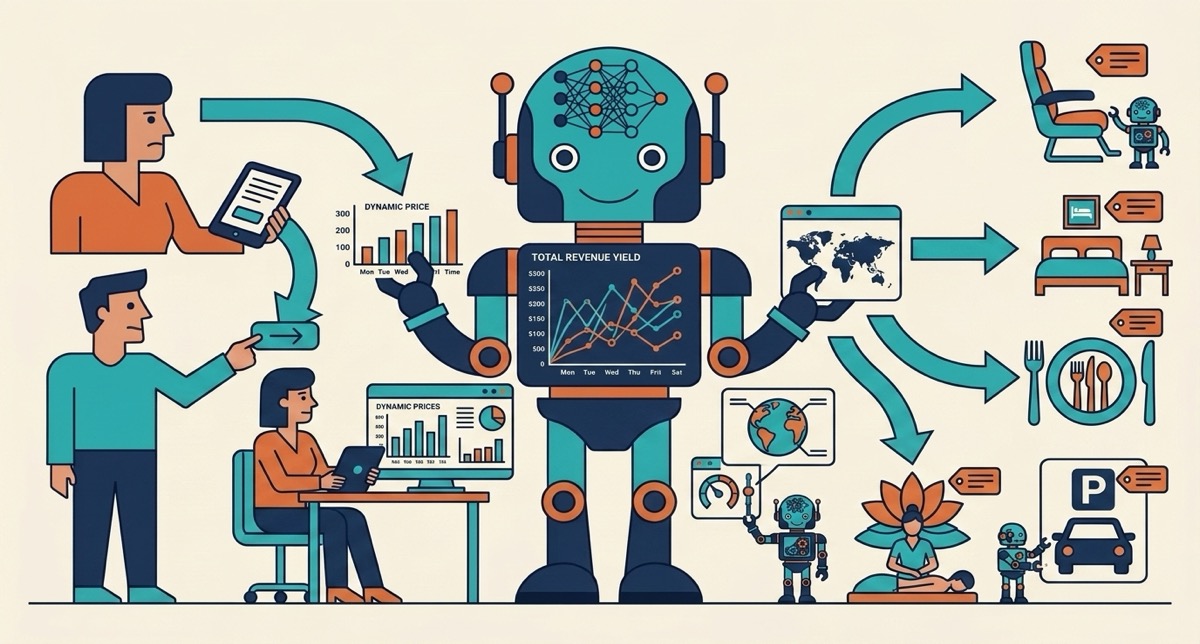
The next generation of yield management goes beyond the room rate or the seat price. It optimises total revenue per guest across every interaction.
Total revenue optimisation. Instead of optimising the room rate in isolation, the system optimises the total guest contribution: room rate plus dining, events space, wellness, parking, minibar, late checkout, room upgrades. A room sold at a lower rate to a guest with high predicted ancillary spend may generate more total revenue than the same room sold at a higher rate to a price-sensitive guest who uses no ancillary services. The AI models guest-level spend propensity and adjusts the pricing and offer strategy accordingly.
In the hospitality revenue work I have been involved in, the shift from room-rate optimisation to total-revenue optimisation typically unlocks 8 to 15% more revenue per available room than dynamic pricing alone. The improvement comes not from charging more but from matching the right guest to the right room at the right price, with the right ancillary offers, at the right time.
Personalised packaging. Rather than presenting a flat rate and a list of add-ons, the system constructs personalised packages based on the individual guest's predicted preferences. A business traveller who always books late checkout and uses the gym receives a rate that bundles those services. A family that consistently books connecting rooms and dines in-house receives a family package. The packaging is dynamic, constructed for each guest based on their history and predicted behaviour, not a static offer from a marketing campaign.
Channel-aware pricing. The system adjusts pricing strategy by distribution channel. A direct booking may receive a lower room rate but higher ancillary offers (because the hotel has more data on direct guests and can personalise more effectively). An OTA booking may receive a competitive rate but fewer personalised touches (because the guest data is thinner). The optimisation accounts for the commission cost of each channel, the lifetime value of the guest in each channel, and the probability of converting an OTA guest to a direct guest on subsequent stays.
The Technical Architecture
Yield management 2030 requires three capabilities that most current revenue management systems do not provide.
Unified guest data. The system needs a single view of each guest across all touchpoints: booking history, on-property spend, loyalty programme activity, channel preferences, and real-time behavioural signals (app usage, WiFi check-in, dining reservations). This is a data integration challenge that most hospitality groups have not fully solved, because guest data is fragmented across PMS, POS, loyalty, CRM, and channel manager systems.
Multi-objective optimisation. Traditional RMS optimises for a single objective (revenue per available room or revenue per available seat-kilometre). Total revenue optimisation requires balancing multiple objectives simultaneously: room revenue, ancillary revenue, guest satisfaction, loyalty programme economics, and channel mix. This is a harder optimisation problem that requires more sophisticated algorithms and more compute.
Real-time decisioning. In a total revenue model, pricing decisions interact. The room rate affects the guest's propensity to purchase ancillary services. The ancillary offer affects the guest's perceived value. The channel choice affects the commission cost and the data available for personalisation. These interactions require real-time decisioning: the system must evaluate the full revenue picture at the point of booking, not adjust the room rate in isolation.
The Human Role in AI Yield Management
Organisations blending human expertise with AI are predicted to see a 25% increase in operational efficiency and customer satisfaction compared to those relying solely on either humans or AI. This finding mirrors the pattern in retail pricing rooms: the AI optimises within boundaries set by humans who hold the strategic context.
In yield management, the human role has three components.
Strategy setting. The revenue manager defines the commercial strategy: positioning relative to the competitive set, target guest mix, channel priorities, and pricing floors and ceilings. The AI operates within this strategic framework, not outside it.
Exception management. When the AI recommends a price or package that conflicts with a strategic commitment (a corporate rate agreement, a promotional promise, a group booking allocation), the revenue manager intervenes. The system should surface these conflicts automatically rather than requiring the revenue manager to monitor every decision.
Market judgement. Events that the AI cannot model from historical data (a new competitor opening, a political event affecting travel patterns, a pandemic, a major sporting event announced after the booking window opened) require human judgement to adjust the strategy. The AI can model the impact of a known event. It cannot model an event it has never seen.
Getting Started
For travel and hospitality boards, the yield management roadmap runs in three phases.
Phase 1: Deploy AI-driven dynamic pricing for the core asset (rooms, seats). This is table stakes in 2026. If your organisation has not done this, it is behind.
Phase 2: Expand to total revenue optimisation. Integrate ancillary revenue streams into the yield management system. Build the unified guest data platform that makes personalised pricing and packaging possible. This is where the 8 to 15% incremental revenue opportunity lives.
Phase 3: Deploy channel-aware, guest-level personalised pricing. This requires the full technical architecture described above and is where the sustainable competitive advantage lives. The firms that reach this phase will outperform on revenue per guest while maintaining or improving guest satisfaction.
The firms still optimising only the room rate are leaving significant revenue on the table. The firms building total revenue optimisation now will compound that advantage through every booking cycle between now and 2030.
*To discuss how the 90-Day AI Acceleration programme can help your organisation build next-generation yield management, contact the Value Institute.*