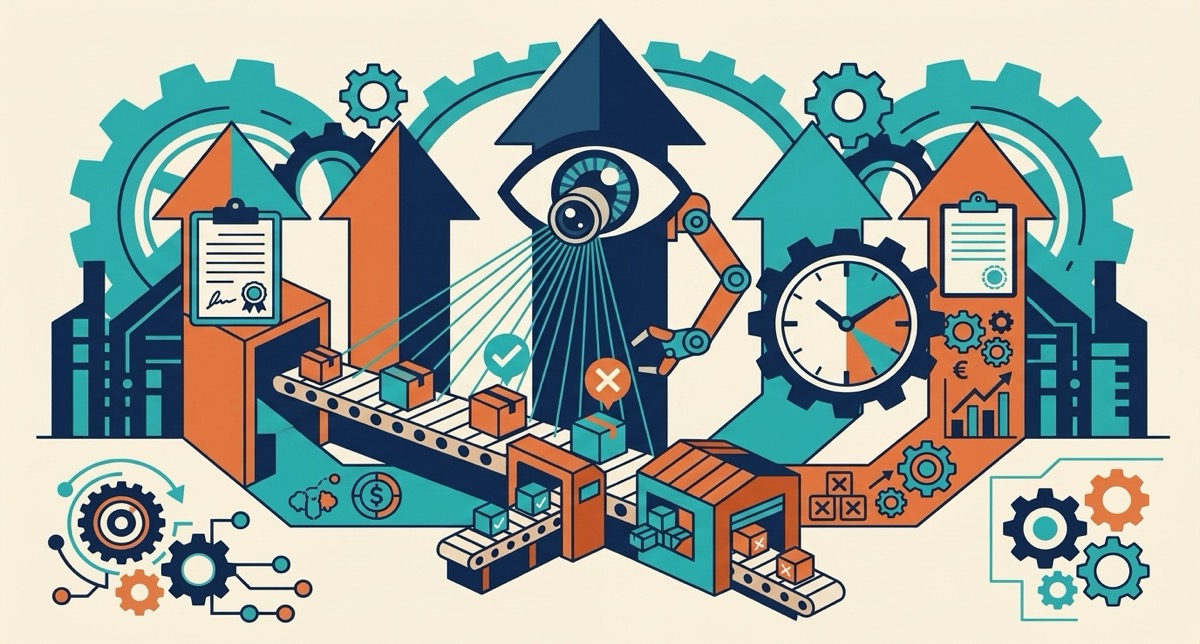
AI vision inspection achieves 95 to 99% detection accuracy consistently across all shifts. Human inspectors achieve 70 to 80% under real production conditions, with accuracy degrading 15 to 25% after two hours and varying significantly between inspectors (55 to 70% inter-inspector agreement on identical defects). The same part passes on first shift and fails on second. This inconsistency is the quality problem that AI vision solves, and the reason that over 70% of manufacturers plan to deploy AI-based visual inspection within 18 months.
Forrester research shows a 374% average three-year ROI with a 7 to 8 month payback period. The commercial case is proven. The implementation challenge is making these systems hold up under the specific conditions of a production environment: shift changes, lighting variations, product mix changes, and the audit requirements that regulated manufacturers must meet.
The Shift Change Problem
The most persistent quality problem in manufacturing is not defect detection. It is consistency. A human inspector's performance varies with fatigue, attention, training, experience, and the subjective threshold they apply to borderline defects.
These variations compound at shift change: a fresh inspector on the morning shift applies different standards from a fatigued inspector at the end of the night shift. The result is that quality data is unreliable, reject rates fluctuate unpredictably, and customers receive inconsistent product quality.
AI vision eliminates this variability. The same criteria are applied to every part, every shift, every week, regardless of time of day, operator, or production speed. This consistency is the primary value, more important than the accuracy improvement itself. A quality system that is 85% accurate but perfectly consistent is more useful than one that averages 90% but swings between 75% and 98% across shifts.
In a manufacturing client I worked with, the shift-to-shift variation in reject rates dropped from plus or minus 12% to plus or minus 1.5% within the first month of AI vision deployment. The production team initially resisted the system because it flagged defects that human inspectors had been passing. Six weeks in, customer complaints on that line fell by 40%. The system was not finding new defects. It was finding the defects that the night shift had been missing.
Design Pattern 1: Production-Grade Image Acquisition
The AI model is only as good as the images it receives. In a laboratory, image quality is controlled. On a production floor, it is not. Lighting changes with the time of day, the season, and the state of the overhead fixtures. Part presentation varies with conveyor speed, operator handling, and upstream process variation. Dirt, oil, condensation, and vibration degrade image quality in ways that the training dataset may not have captured.
The pattern that holds up at scale:
Controlled illumination. Enclose the inspection station with consistent, purpose-built lighting. Do not rely on ambient light. Use diffuse lighting to eliminate reflections and shadows. For metallic or glossy surfaces, use structured light (line lasers or patterned projection) to capture surface geometry that flat lighting misses.
Redundant cameras. Use multiple cameras at different angles rather than a single camera that must capture everything. This reduces the model's burden: each camera has a simpler classification task, and the system combines results for a final disposition. It also provides tolerance to single-camera failures.
In-line validation. Include reference standards (known-good and known-defective parts) in the inspection flow at defined intervals. The system inspects the reference and compares the result to the known ground truth. If the system misclassifies a reference part, it triggers an alert. This catches model degradation in real time, before it affects production quality.
Design Pattern 2: Model Robustness Across Product Mix
Most AI vision systems are trained on a specific product or a narrow range of products. When the product mix changes (a new SKU, a design revision, a colour change), the model's accuracy may drop. This is the most common cause of AI vision failure in production: the model works well on the products it was trained on and fails silently on products it has not seen.
The pattern that works:
Product-aware model switching. The system identifies the product (from the MES, from a barcode, or from the image itself) and loads the appropriate model. Each product or product family has its own trained model, rather than a single model attempting to handle all products.
New product qualification process. Before a new product enters production, the vision system must be qualified on that product. This means collecting a training dataset (including known defects), training or fine-tuning the model, validating accuracy against a held-out test set, and confirming that the model meets the required detection threshold. This qualification process must be part of the new product introduction procedure, not an afterthought.
Continuous learning with guardrails. The system collects images from production and uses them to improve the model over time. But the retraining must be controlled: new data is reviewed by quality engineers before being added to the training set, and the retrained model is validated before being deployed. Uncontrolled continuous learning, where the model retrains on its own classifications, can drift: the model learns to replicate its own errors.
Design Pattern 3: Audit-Grade Logging
Regulated manufacturers (automotive, aerospace, pharmaceutical, medical device) must demonstrate traceability: for any product shipped, they must be able to show what inspection was performed, what the result was, and what disposition was taken. AI vision systems must meet this standard.
The audit-grade logging pattern:
Every inspection logged. For every part inspected, the system stores: the image, the timestamp, the product identifier, the model version, the classification result (pass/fail and defect category if applicable), the confidence score, and the disposition (shipped, reworked, scrapped).
This record must be immutable and retained for the period required by the relevant quality standard (typically 5 to 15 years for automotive and aerospace).
Traceability linkage. The inspection record must be linked to the part's serial number or batch number, so that a customer complaint on a specific part can be traced back to the inspection image and result. This requires integration between the vision system and the MES or quality management system.
Model version control. When the model is updated, the previous version is archived. For any historical inspection, it must be possible to determine which model version was used. If a model update later proves to have reduced accuracy on a specific defect type, the manufacturer can identify which parts were inspected with the affected model and take appropriate action.
Scaling from One Line to the Plant
The most common deployment pattern for AI vision QC is to start on a single production line, prove the system, then scale across the plant. The scaling challenges are different from the initial deployment challenges.
Infrastructure. Each inspection station requires cameras, lighting, compute (often edge compute for latency-sensitive inspection), and network connectivity. At plant scale, this is a significant infrastructure investment. The compute architecture must handle the throughput: a high-speed production line generating 60 parts per minute requires sub-second inference, which constrains the model complexity and the hardware specification.
Standardisation. The inspection stations across the plant should use standardised hardware, standardised lighting, and standardised model architectures. This simplifies maintenance, reduces spare parts inventory, and enables quality engineers to move between lines without retraining. Bespoke solutions for each line create a maintenance burden that does not scale.
Central monitoring. A plant-level dashboard that shows real-time quality performance across all lines, shift-by-shift trends, and model health indicators. This is the quality manager's view: not the detail of individual inspections, but the system-level performance that determines whether quality targets are being met and whether any line or shift requires attention.
The manufacturers that deploy AI vision QC successfully at scale are the ones that treat it as a quality system, not a technology project. The technology is the enabler. The value is in consistent, auditable, shift-independent quality that their customers can rely on.
*To discuss how the 90-Day AI Acceleration programme can help your manufacturing organisation deploy AI vision QC at scale, contact the Value Institute.*