
When I ask leaders how they measure the return on their AI investment, most of them start with cost savings. "We automated this process and saved that many headcount." It's the most common metric and the most intuitive. It's also the least interesting.
Cost savings are real and they matter. But if that's all you're measuring, you're missing most of the value.
The cost savings trap
Cost reduction is where most AI business cases start because it's easy to quantify. The saving is obvious. But there are two problems with making it your primary AI metric.
First, it caps your ambition. If every AI initiative is justified by headcount reduction, you'll only pursue automation use cases. You'll miss the applications that drive revenue growth, improve decision quality, or create entirely new business models.
Second, it creates political resistance. Nobody wants to be the department that gets "optimised." When AI equals job cuts in people's minds, you get resistance and quiet sabotage. I've seen technically strong AI projects fail because the team responsible for adoption had every incentive to make them fail.
A broader measurement framework
The organisations that extract the most value from AI measure across four dimensions. I call this the Value Compass.
1. Efficiency (cost and time)
This is the traditional metric and it still matters. But frame it as time saved and process speed, not just headcount. "We reduced claim processing from 14 days to 3 days" tells a better story than "We cut five FTEs."
Time savings compound. When a process runs five times faster, everything downstream speeds up: decisions happen sooner, customers get served faster, revenue arrives earlier. These knock-on effects are often worth more than the direct labour saving.
2. Revenue (growth and retention)
AI that drives top-line growth is worth more than AI that cuts costs. But it's harder to measure, which is why most organisations don't bother. That's a mistake.
Where I've seen this work: AI-driven personalisation improving cross-sell rates by about 15%. Predictive analytics identifying at-risk customers 90 days before churn. Dynamic pricing models improving margins by 3 to 5 percentage points.
The key is attribution. You need a clear methodology for connecting the AI output to the revenue outcome. A/B testing is the gold standard, but even simple before-and-after analysis with appropriate controls can work.
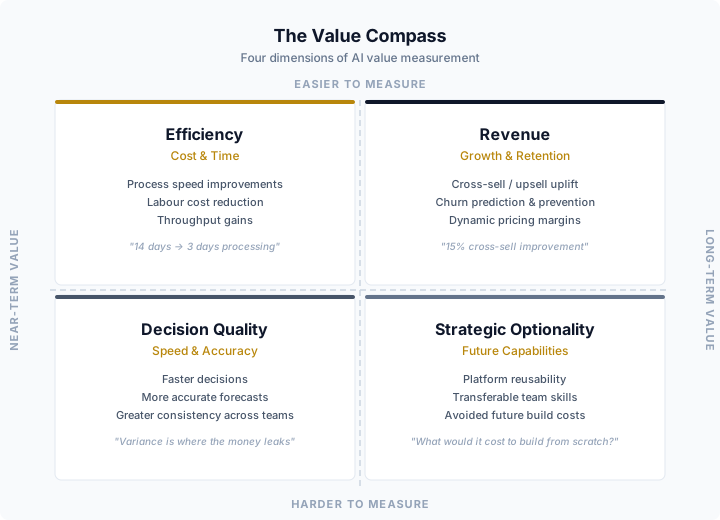
3. Decision quality
This is the dimension many organisations overlook, and it may be the most valuable. AI that helps leaders make better decisions, faster, creates compounding value.
How do you measure it? Look at proxies:
Speed to decision. How long does it take to approve a credit application, allocate a budget, or respond to a market shift?
Accuracy of forecasts. Are your demand forecasts and risk assessments getting more accurate over time?
Consistency. Are different teams making consistent decisions based on the same data? In most organisations, the variance is where the money leaks out.
4. Strategic optionality
Some AI investments don't pay off immediately but create options that are valuable in themselves. A customer data platform built for one use case might enable ten future use cases. A team skilled in machine learning for fraud detection can pivot to credit scoring when the business needs it.
You can value this using real options thinking. What would it cost to build this capability from scratch in 18 months if you needed it urgently? That avoided cost is a representation of the option value.
Building the measurement system
A practical measurement system needs three things.
Leading indicators tell you whether the AI is being adopted and used correctly. Track them monthly: adoption rate, usage frequency, process compliance.
Lagging indicators tell you whether the AI is delivering business value. Track them quarterly: financial impact, processing speed, error rates, customer satisfaction.
The bridge between them is the critical piece most organisations miss. If adoption goes up but financial impact doesn't follow, it's an indicator something is broken in the value chain. Maybe the process around the AI hasn't changed. Maybe people are using the tool but ignoring its recommendations. Understanding that connection separates organisations that measure AI from organisations that manage AI.
What this means for you
If your AI measurement framework starts and ends with cost savings, expand it:
Map your current AI portfolio against all four dimensions of the Value Compass. If everything lives in the efficiency quadrant, you've got a strategic blind spot.
Pick one non-cost metric for each major AI initiative. Revenue attribution, decision speed, or strategic optionality. Start measuring it even if the methodology is imperfect.
Build the leading-to-lagging bridge. For each initiative, define what adoption looks like and what business outcome it should drive.
Cost savings normally gets AI through the door. But if you want to really drive business impact with AI, you need to show that it drives growth, improves decisions, and creates future options.