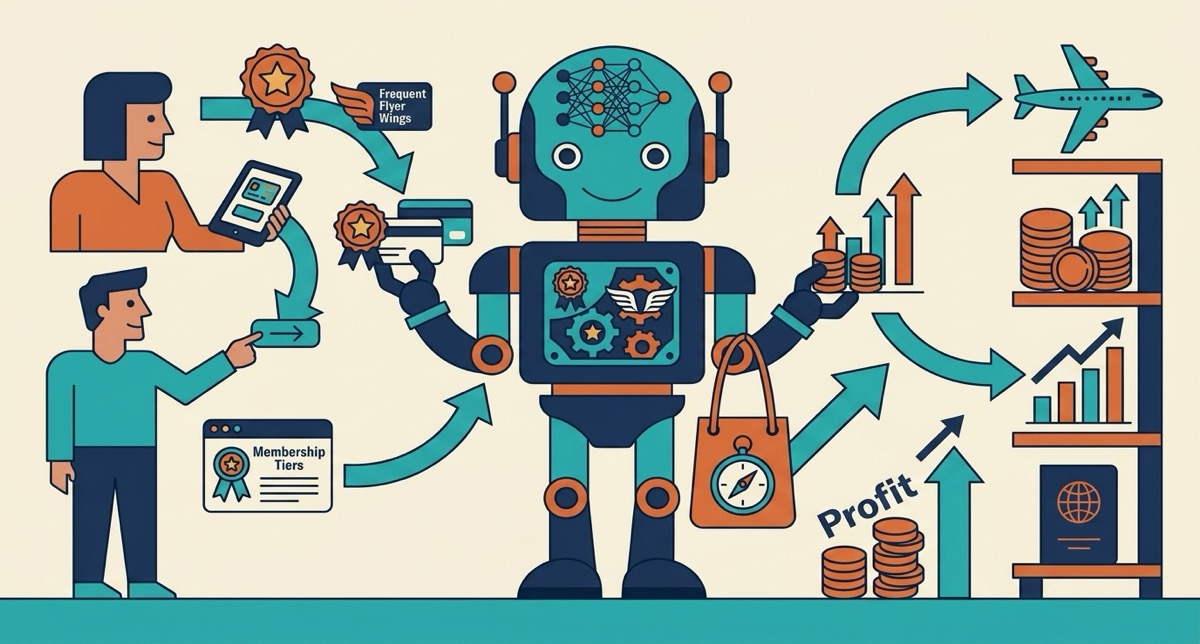
OTAs impose commission costs of 15 to 25% per booking. Direct bookings are often twice as profitable as OTA reservations. In an industry where net margins run 5 to 15% for hotels and 3 to 7% for airlines, the difference between a guest who books direct and one who books through an OTA is the difference between a profitable stay and a marginal one.
This is why loyalty programmes are no longer marketing exercises. They are P&L assets. The firms that manage their loyalty programmes as operating profit centres, with AI powering the personalisation, pricing, and engagement that drive direct bookings and repeat stays, will outperform those that treat loyalty as a points-and-perks catalogue.
The P&L Logic
The economics of loyalty in travel are straightforward, but most boards do not see them presented clearly.
Acquisition cost differential. Acquiring a guest through an OTA costs 15 to 25% of the booking value in commission. Acquiring the same guest through the loyalty programme costs a fraction of that: the cost of the loyalty reward (typically 3 to 8% of spend when amortised) plus the marketing cost of maintaining the programme. The differential is 10 to 20 percentage points of margin on every booking that shifts from OTA to direct.
Repeat purchase economics. A loyalty member books more frequently and spends more per stay than a non-member. Industry data shows loyalty members generate 30 to 50% more revenue per year than non-members, driven by higher booking frequency, higher ancillary spend, and lower price sensitivity. This is not because loyalty programmes attract inherently higher-value guests. It is because the programme creates a behavioural reinforcement loop: rewards encourage repeat booking, repeat booking generates data, data enables personalisation, personalisation increases satisfaction, and satisfaction drives further loyalty.
Data value. The loyalty programme generates first-party data that powers AI personalisation, revenue management, and operational optimisation across the entire business. This data is a strategic asset whose value extends far beyond the loyalty programme itself. In the agentic commerce era, where AI agents will select travel providers based on structured data, the loyalty programme's data becomes the foundation for machine-readable product differentiation.
When these three value streams are combined and attributed correctly, the loyalty programme is not a cost centre with an annual budget. It is a profit centre with a P&L.
AI's Role in the P&L
AI transforms the loyalty programme from a static reward scheme to a dynamic profit optimisation system. Three capabilities drive the P&L impact.
Personalised engagement. AI analyses each member's behaviour (booking patterns, spend distribution, channel preferences, engagement frequency) and delivers personalised communications, offers, and rewards that maximise the probability of the desired action (a direct booking, an ancillary purchase, a programme upgrade). Generic "earn 5 points per pound" schemes are being replaced by individualised reward structures that vary the offer based on the member's predicted behaviour.
Hotels are reinventing their loyalty programmes with AI personalisation to win direct bookings in the agentic age. Marriott, Hilton, and other major chains are deploying AI to personalise loyalty offers at the individual level, moving from segment-based marketing to one-to-one engagement. Gartner projects that one in five loyalty programmes could move to fully individualised rewards by 2030.
Churn prediction and intervention. AI identifies members at risk of lapsing (declining booking frequency, reduced engagement, competitive bookings detected through payment data) and triggers targeted retention interventions before the member disengages. In the loyalty programmes I have worked with, AI-driven churn prediction and proactive retention have reduced member attrition by 15 to 25% compared to rule-based retention programmes. The value is not just in retaining the member's future bookings but in preserving the lifetime value of the data relationship.
Lifetime value-based investment. Instead of treating all loyalty members equally, AI calculates each member's predicted lifetime value and adjusts the programme's investment accordingly. A high-LTV member who is showing churn signals receives a high-value intervention (a complimentary upgrade, a personalised offer, a proactive outreach from a human relationship manager). A low-LTV member who is stable receives standard programme benefits. This allocation of programme resources by predicted value maximises the programme's return on investment.
Loyalty in the Agentic Era
The emergence of agentic booking creates a new challenge for loyalty programmes. When an AI agent books on behalf of a traveller, the agent does not respond to emotional loyalty. It optimises on the parameters the traveller has set: price, location, quality ratings, amenities. Brand loyalty is relevant only if the traveller has explicitly instructed the agent to prefer a specific programme.
This means loyalty programmes must evolve to be machine-readable. The benefits of membership (guaranteed room type, free breakfast, late checkout, lounge access, priority rebooking) must be expressible as structured data that an AI agent can factor into its booking decision. A loyalty programme whose value proposition is experiential ("the warm feeling of being recognised") has no mechanism to influence an agent's decision. A loyalty programme whose value proposition is quantifiable ("£45 of included benefits per night, 23% faster check-in, guaranteed room availability for status members") gives the agent concrete reasons to prefer the programme.
BCG's 2026 research on AI-first hotels argues that loyalty programmes must become lifestyle-integrated ecosystems rather than transaction-based point schemes. This is correct strategically, but the tactical imperative is simpler: make the programme's value machine-readable, measurable, and consistently delivered.
Board Governance
For travel boards, governing the loyalty programme as a P&L requires three shifts.
First, establish loyalty P&L reporting. The loyalty programme should have its own profit and loss statement: revenue attributed to loyalty-driven direct bookings, ancillary revenue from personalised offers, cost of rewards, programme operating costs, and net contribution. This P&L should be reviewed at the same cadence as the business unit P&Ls it supports.
Second, invest in AI as the programme's operating system. The personalisation engine, churn prediction, lifetime value modelling, and dynamic reward structures are not optional add-ons. They are the mechanisms through which the programme generates its financial return. The AI investment should be governed as part of the loyalty P&L, not as a separate technology budget.
Third, prepare for the agentic channel. Ensure the programme's benefits are structured, quantifiable, and accessible via API. Test how the programme performs when an AI agent, rather than a human traveller, makes the booking decision. The programmes that are optimised for agent-mediated booking will capture disproportionate share as agentic adoption grows.
The loyalty programme is the travel company's most valuable customer asset. AI turns that asset into a P&L. The boards that govern it accordingly will outperform those that still treat it as a marketing line item.
*To discuss how the 90-Day AI Acceleration programme can help your organisation turn its loyalty programme into a profit centre, contact the Value Institute.*