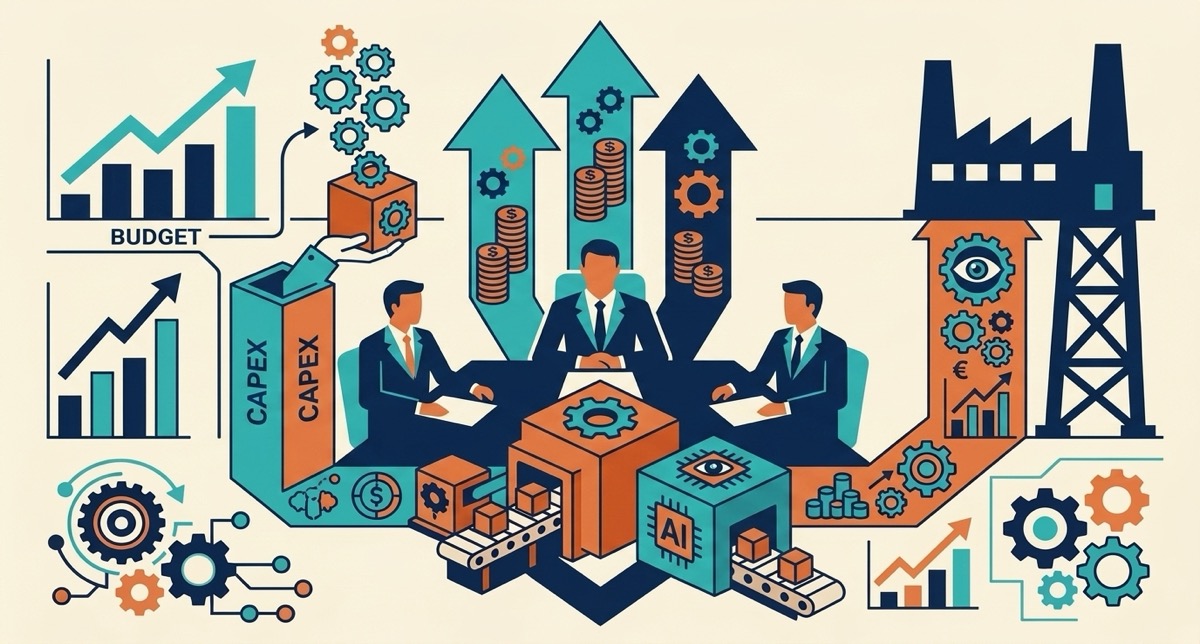
Manufacturing boards understand capital investment. They approve machine tools, production lines, factory expansions, and automation equipment using frameworks that have been refined over decades: payback period, IRR, NPV, capacity utilisation impact. AI investment should be governed with the same rigour, but in most manufacturing companies it is not. AI sits in the IT budget, or in an innovation fund, or in a departmental discretionary spend. It is treated as an operating expense when it should be treated as a capital asset.
The distinction matters. An AI system that optimises production scheduling, predicts maintenance requirements, or performs quality inspection is not a consumable. It is a capability that improves over time, generates returns over multiple years, and depreciates as the underlying technology evolves. It belongs in the capital plan, with the same governance, the same measurement, and the same board-level accountability as a new production line.
The Industrial CapEx Classification
Under IAS 38 and IFRS intangible asset capitalisation criteria, an AI system qualifies as a capital asset when it has a useful life beyond one year, generates measurable economic benefit, and its cost can be reliably measured. By this definition, most production-floor AI systems are capital assets: vision QC systems, predictive maintenance platforms, S&OP optimisation engines, and process control AI all meet the criteria.
Classifying AI as capex rather than opex has three governance benefits. First, it subjects AI investment to the same approval process as other capital expenditure, which forces a structured business case. Second, it enables depreciation, which aligns the cost recognition with the benefit realisation over the asset's useful life. Third, it makes AI investment visible to the board in the same capital review that governs all other major investments, rather than hiding it in operating budgets where it is difficult to track and easy to cut.
Where the Returns Come From
For manufacturing boards evaluating AI investment, the returns come from four sources.
Quality improvement. AI vision QC at scale delivers a 374% average three-year ROI with a 7 to 8 month payback, according to Forrester's 2024 Total Economic Impact study of computer vision in manufacturing. The return comes from reduced scrap, reduced rework, fewer customer complaints, and lower warranty costs. For a manufacturer spending 2 to 5% of revenue on cost of poor quality, a 30 to 50% reduction is material.
Predictive maintenance. AI-driven predictive maintenance reduces unplanned downtime by 30 to 50% and extends equipment life by 10 to 20%, according to McKinsey's 2025 manufacturing operations survey. For a manufacturer where a single production line generates 50,000 to 100,000 pounds of revenue per hour, reducing unplanned downtime by even a few hours per month is a significant return.
Planning optimisation. Continuous AI-driven S&OP reduces forecast error (typically by 15 to 25%), reduces inventory holding costs (typically by 10 to 15%), and improves capacity utilisation (typically by 5 to 10%). These returns are harder to attribute cleanly because they interact with market conditions and operational decisions, but the aggregate impact on working capital and margin is measurable.
Energy and resource optimisation. AI-driven energy management and process optimisation reduce consumption by 5 to 15% in energy-intensive manufacturing (metals, chemicals, glass, cement). With energy costs representing 10 to 30% of production cost in these sectors, the return is directly measurable on the utility bill.
The Capital Case Framework
A board-ready AI capital case for manufacturing should answer five questions.
What is the total investment? Not just the software. The full cost includes:
- Hardware: cameras, sensors, edge compute, network infrastructure
- Software: licences, development, integration
- Data: collection, cleaning, labelling, governance
- Talent: data engineers, ML engineers, quality engineers with AI skills
- Change management: training, process redesign, organisational adjustment
- Compliance: AI Act documentation, conformity assessment, ongoing monitoring
In the manufacturing AI programmes I have been involved in, the technology cost is typically 30 to 40% of the total. The remaining 60 to 70% is data, people, process, and governance.
What is the expected return? Quantified by source (quality, maintenance, planning, energy), with a baseline measurement, a target, and a timeline. Each return source should have a confidence level. Quality improvement returns are high-confidence (proven, measurable, short payback). Planning optimisation returns are medium-confidence (measurable but harder to attribute). New capability returns (products or services that AI enables) are lower-confidence (strategic, longer-term, dependent on market factors).
What is the payback period? For each investment tranche, when does the cumulative return exceed the cumulative investment? Vision QC typically pays back in 7 to 8 months. Predictive maintenance typically pays back in 12 to 18 months. Planning optimisation typically pays back in 18 to 24 months. The board should see a phased return profile, not a single aggregate number.
What is the risk? Four categories matter:
- Technical risk: the AI does not perform as expected
- Operational risk: the organisation cannot adopt the AI effectively
- Regulatory risk: compliance costs are higher than estimated
- Market risk: the competitive landscape changes the value of the investment
Each risk should have a mitigation plan. A portfolio approach with an explicit failure budget (expect 20 to 30% of initiatives to underperform) is more honest and more useful than a case that assumes every initiative succeeds.
What is the governance model? Who owns AI investment decisions? Who is accountable for returns? How is performance measured and reported to the board? The governance model should integrate AI investment into the existing capital review process rather than creating a parallel approval track that operates to different standards.
The Board Conversation
The manufacturing boards I advise are moving from "should we invest in AI?" to "how do we govern AI investment with the same discipline we apply to everything else?" The answer is to put AI in the capital plan, next to the production line it optimises, the factory it operates in, and the products it inspects. When AI investment is visible, governed, and measured alongside every other capital asset, the board can make informed decisions about scale, timing, and risk.
The alternative, continuing to fund AI from IT budgets and innovation funds, produces incremental improvements that are difficult to measure, easy to cut, and invisible to the board. In 2026, with AI delivering proven returns in quality, maintenance, planning, and energy, that approach is leaving value on the factory floor.
*To discuss how the 90-Day AI Acceleration programme can help your manufacturing board build an AI capital case, contact the Value Institute.*