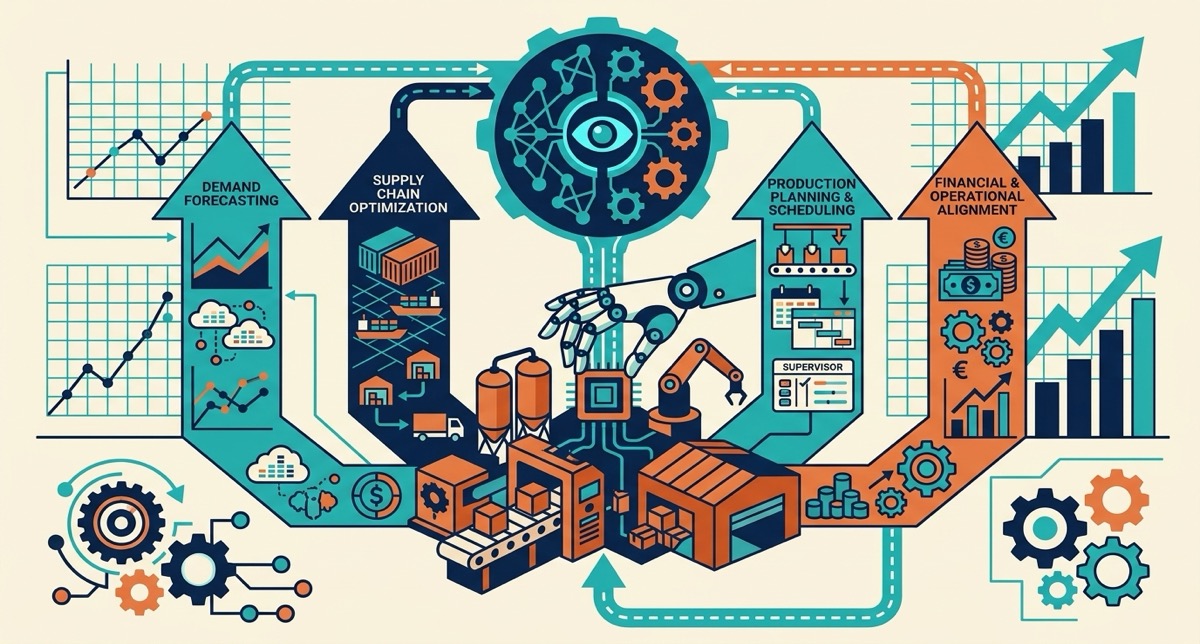
Sales and operations planning in most manufacturing companies is a monthly cycle. Demand planners produce a forecast. Supply planners build a production plan against it. Finance reconciles the numbers. The leadership team reviews and approves.
By the time the plan is signed off, the data it was built on is already stale. Customer orders have shifted. A supplier has flagged a delay. A raw material price has moved. The plan is wrong before it starts, and the organisation spends the rest of the month reacting.
AI changes the cadence. Companies that have adopted AI-powered S&OP tools consistently report planning cycles that are dramatically faster, often completing in days what previously took weeks. But speed is not the point. The point is continuity. Instead of reviewing plans monthly and adjusting quarterly, AI-driven S&OP monitors data in real time, adjusts forecasts as signals change, and recommends plan modifications continuously. The monthly S&OP meeting does not disappear, but its purpose shifts from "approve the plan" to "review the AI's recommendations and make the judgement calls the AI cannot."
From Monthly Cycle to Continuous Optimisation
The traditional S&OP cycle is sequential: demand planning, then supply planning, then financial reconciliation, then executive review. Each step depends on the output of the previous step. This sequential design is a constraint, not a feature. It exists because human planners cannot run all four steps simultaneously. AI can.
Digital twin architectures, such as those offered by o9 Solutions and similar platforms, enable demand and supply planning to run simultaneously rather than sequentially. A change in demand forecast instantly propagates to supply planning, which recalculates production schedules, procurement requirements, and inventory positions. Finance sees the P&L impact in real time. The leadership team can intervene at any point, not just at the end of the cycle.
In a manufacturing client I advised, the shift from monthly to continuous S&OP reduced forecast error by 22% and cut inventory holding costs by 14% within two quarters. The improvement came not from better forecasting algorithms (though those helped) but from faster response to forecast changes. In the old model, a demand signal that arrived on day 15 of the month was not reflected in the plan until the next cycle. In the continuous model, it was reflected within hours.
The Agentic S&OP Layer
SAP's 2026 supply chain trends report identifies agentic AI as the next evolution: AI assistants for each planning role (material planner, demand planner, commercial planner) that collaborate to generate recommendations, identify risks, and trigger corrective actions. These are not chatbots. They are autonomous agents embedded in the planning process, monitoring data streams and intervening when conditions change.
The practical applications are specific:
Demand sensing. The AI monitors external signals (point-of-sale data, web traffic, weather, economic indicators, social media sentiment) and adjusts demand forecasts before the signals show up in order data. A traditional demand planner updates forecasts monthly based on historical patterns. An agentic demand system updates continuously based on leading indicators.
Supply risk detection. The AI monitors supplier performance, logistics disruptions, commodity prices, and geopolitical events. When a risk materialises (a port closure, a supplier quality issue, a tariff change), the system immediately models the impact on the production plan and recommends alternatives: alternative suppliers, schedule adjustments, inventory reallocation.
Scenario simulation. The AI runs thousands of what-if scenarios against the current plan: what happens if demand increases by 15%? What if a key supplier fails? What if a raw material price spikes? The planning team sees the range of outcomes and the sensitivity of the plan to each variable. This replaces the traditional approach of building one plan and hoping it survives contact with reality.
Cross-functional optimisation. The AI balances competing objectives across functions: sales wants to maximise revenue, manufacturing wants to maximise utilisation, finance wants to minimise working capital, logistics wants to minimise transport cost. The AI finds the Pareto-optimal plan that satisfices across all objectives, rather than the siloed plans that each function optimises independently.
What the Board Needs to Understand
For manufacturing boards, the shift to continuous AI-driven S&OP is not a technology upgrade. It is an operating model change with three implications.
First, the planning organisation changes. The role of the demand planner shifts from producing forecasts to reviewing, challenging, and overriding AI-generated forecasts. The role of the supply planner shifts from building production schedules to managing exceptions and making the judgement calls that the AI surfaces.
This requires different skills, different metrics, and different leadership. In the manufacturing transformations I have been involved in, the organisational change is harder than the technology implementation. The planners who thrive are the ones who are analytically curious and willing to trust the AI for routine decisions while focusing their expertise on the decisions the AI cannot make.
Second, the data infrastructure must support real-time planning. Most manufacturing ERP systems were designed for batch processing. They update overnight. They reconcile weekly.
Continuous S&OP requires data that is current within hours, sometimes minutes. This means integration between ERP, MES, WMS, TMS, and external data sources at a cadence that most manufacturers' IT architecture does not currently support. The data infrastructure investment is typically the largest cost item in a continuous S&OP programme.
Third, the governance model must accommodate faster decisions. If the AI recommends a production schedule change at 2pm on a Wednesday, who authorises it? In a monthly S&OP cycle, the leadership team authorises the plan once a month.
In a continuous model, authorisation must be delegated: routine adjustments within defined parameters are executed automatically; material changes above defined thresholds are escalated to the appropriate decision-maker. Defining those parameters and thresholds is a governance decision, not a technology decision.
Getting Started
The manufacturers making the fastest progress are starting with demand sensing (the quickest to implement and the most immediately measurable), then expanding to supply risk detection, then building towards full continuous S&OP. This phased approach allows the organisation to build confidence in the AI's recommendations before delegating more decision-making authority.
The goal is not to replace the S&OP meeting. It is to make the S&OP meeting the forum where leaders apply judgement to a plan that is already good, rather than the forum where leaders try to build a plan from scratch.
*To discuss how the 90-Day AI Acceleration programme can help your manufacturing organisation transition to continuous AI-driven S&OP, contact the Value Institute.*