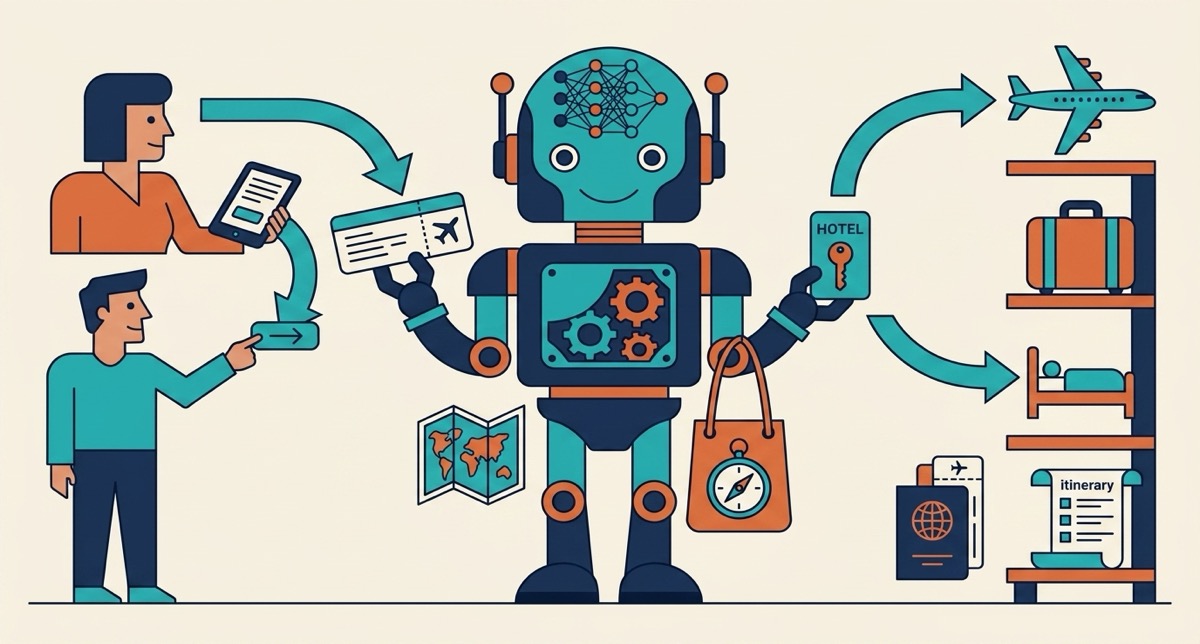
In March 2026, Sabre, PayPal, and MindTrip announced the travel industry's first end-to-end agentic AI booking pipeline: conversational trip planning, real-time inventory across 420 airlines and 2 million hotels, and integrated payment in a single chat-based experience. Google launched agentic travel planning in Search. Malaysia Airlines deployed "Mavis," an agentic customer service agent that autonomously handles booking tasks across web, app, and email. OAG declared March 2026 the month agentic travel got real.
The industry is moving fast. Consumer adoption is not. Only 2% of US consumers say they are willing to let an AI agent book travel autonomously on their behalf. Eighty percent of travel executives plan to deploy agentic systems at scale. This gap between supply-side enthusiasm and demand-side caution defines the strategic challenge for travel companies in 2026.
What Agentic Travel Actually Looks Like
Agentic trip planning is not a chatbot that answers questions about flight times. It is an AI system that autonomously plans, compares, and books travel on behalf of a user, executing multi-step tasks (searching, comparing, booking, rebooking) without human intervention at each step.
The emerging model has three levels of delegation, similar to agentic commerce in retail.
Level 1: Research and recommendation. The agent searches across airlines, hotels, and activities based on the traveller's preferences, compiles options, and presents a curated selection. The traveller makes every decision. This is where most current implementations sit: a better search engine, not a booking agent.
Level 2: Rule-based booking. The traveller sets parameters ("business class to Tokyo, departing between March 10 and 12, under £3,000, aisle seat, Marriott or Hyatt within 15 minutes of the conference venue") and the agent books within those parameters. The traveller approves the final itinerary or authorises the agent to book if all criteria are met.
Level 3: Preference-learned autonomy. The agent learns from the traveller's history what they prefer and acts on those learned preferences without explicit rules for each trip. "Book my usual for the quarterly board meeting in Frankfurt" triggers the agent to replicate the pattern from previous trips, adjusting for date and availability.
The commercial opportunity is largest at Level 2, where the value proposition is clear (time saving, optimisation) and the trust requirement is manageable (the traveller defines the boundaries). Level 3 requires deep trust that most consumers have not yet developed with AI systems.
What Changes for Travel Companies
Three structural shifts follow from agentic booking.
Distribution economics restructure. When an AI agent books travel, it does not visit the airline's website, scroll through the hotel's gallery photos, or respond to retargeting ads. It queries APIs. The entire top-of-funnel marketing stack, search engine optimisation, display advertising, social media marketing, becomes less effective for agent-mediated bookings. Distribution cost shifts from marketing spend to API infrastructure and commercial agreements with agent platforms.
In the travel advisory work I have been involved in, the companies asking the right question are not "how do we market to AI agents?" but "how do we ensure our inventory is discoverable, bookable, and accurately represented in the agent's decision set?" This requires real-time API access to pricing, availability, and product attributes in structured, machine-readable formats. Hotels and airlines whose inventory is accessible only through their own website or through legacy GDS connections will be invisible to agentic booking systems.
Price transparency becomes absolute. An AI agent comparing flights across 420 airlines in real-time eliminates the information asymmetry that revenue management has historically relied on. The agent finds the cheapest qualifying option instantly. Brand premium survives only where the traveller has explicitly instructed the agent to prefer a specific airline or hotel chain, or where product attributes (schedule, loyalty status, lounge access) justify the price difference in terms the agent can evaluate.
For travel companies, this means the competitive basis shifts. Price competition intensifies for commoditised inventory. Product differentiation must be expressed in structured data that agents can parse: not "our hotel has a great atmosphere" but "our hotel has a 4.7 guest rating, a 12-minute taxi to the conference centre, a 24-hour gym, and complimentary breakfast included in the rate." The companies that make their differentiation machine-readable will win agent-mediated bookings on merit, not just on price.
The rebooking opportunity. Skift's analysis identifies rebooking as the most immediate practical application of agentic AI in travel. When a flight is cancelled or delayed, the agent automatically searches for alternatives, rebooks the traveller, adjusts the hotel reservation, and notifies relevant parties. No phone queue, no frantic app refreshing, no missed connections. This is where consumer trust in agentic travel will be built: in moments of disruption where the agent's speed and comprehensiveness demonstrably outperform the traveller's own ability to manage the situation.
The 2% Problem
The gap between 80% executive enthusiasm and 2% consumer willingness is the central strategic risk. Skift's March 2026 analysis was blunt: "Travel brands are building AI agents for a consumer that doesn't exist."
The resolution lies in progressive delegation. Consumers will not jump from manual booking to full autonomy. They will move through the levels: first letting the agent research, then letting it book within defined rules, then (for some travellers, eventually) letting it act on learned preferences. Travel companies that design for this progression, with clear controls, transparent decision-making, and easy override at every step, will build the trust that drives adoption.
The companies that deploy fully autonomous agents before consumers are ready will generate impressive demos and minimal revenue. The companies that meet consumers where they are, starting with research assistance and rule-based booking, will build the usage patterns that eventually support higher levels of delegation.
Preparing for the Shift
For travel company boards, four priorities:
First, invest in API infrastructure. Make your inventory discoverable, bookable, and accurately represented in structured formats that AI agents can query. This is the minimum requirement for participation in the agentic channel.
Second, structure your product differentiation for machine readability. Every attribute that differentiates your product (location, quality ratings, amenities, schedule, loyalty benefits) must be available as structured data, not just as marketing copy on your website.
Third, build for progressive delegation. Design your agentic interfaces to support all three levels: research, rule-based booking, and preference-learned autonomy. Start with the levels consumers are ready for. Scale as trust develops.
Fourth, invest in rebooking capability. This is where consumer trust in agentic travel will be built. A system that handles disruption better than the traveller can handle it themselves is the most powerful demonstration of value.
The agentic travel market will develop unevenly. Business travellers with high frequency and strong preferences will adopt faster than leisure travellers with emotional, exploratory purchase patterns. The companies that understand this segmentation and build accordingly will capture the early market.
*To discuss how the 90-Day AI Acceleration programme can help your travel organisation prepare for agentic booking, contact the Value Institute.*