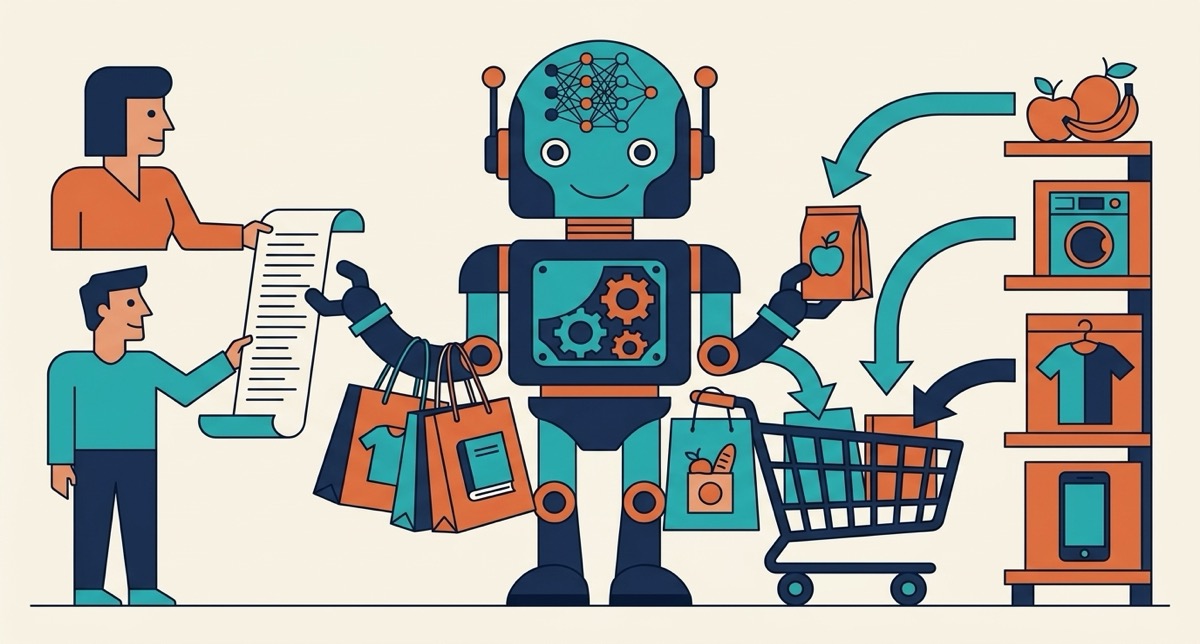
Consumers will not browse. They will delegate. That is the core prediction from every major research house examining retail in 2026, and the behavioural shift is already measurable. McKinsey's analysis of agentic commerce identifies a structural change: the consumer behaviours that took a decade to develop during the rise of e-commerce are now transforming in 12 to 24 months, with the fastest changes occurring around household replenishment, price comparison, and product discovery.
The retail categories most exposed are the ones where the value of shopping lies in efficiency, reliability, and predictability rather than discovery or expression. Groceries. Household essentials. Basic consumables. These are the categories where an AI agent that knows your preferences, your dietary requirements, your budget, and your schedule can outperform your own decision-making. Not because the agent is smarter, but because it is more consistent, more patient, and more willing to compare 40 options than you are on a Tuesday evening.
The Delegation Curve
Not all shopping will be delegated equally. Deloitte's 2025 agentic commerce framework maps consumer willingness to delegate against purchase risk. Low-regret purchases (groceries, cleaning products, pet food) are natural candidates for high autonomy: the agent places the order within defined parameters, and the consumer reviews after the fact. High-consideration purchases (electronics, furniture, fashion) remain in the "assist" zone: the agent researches, compares, and recommends, but the consumer decides.
The delegation levels that are emerging in practice:
Level 1: Research delegation. The agent gathers information, compares products, and presents options. The consumer makes every decision. This is where most agentic shopping is today.
Level 2: Rule-based delegation. The consumer sets parameters ("if groceries are under £120 and arrive Friday between 6 and 8pm, place the order") and the agent executes within those boundaries. This is where the fastest growth is happening in 2026, particularly in grocery and household essentials.
Level 3: Preference-learned delegation. The agent learns from repeated interactions what the consumer prefers and acts on those learned preferences without explicit rules. This is technically feasible but consumer trust is the bottleneck. Only 29% of surveyed shoppers in the US and UK express excitement about agentic shopping; nearly half describe it as intrusive or unnecessary.
The gap between technical capability and consumer readiness is the strategic window for retailers. The firms that build the infrastructure for agentic commerce now, while consumer adoption is still early, will be positioned to capture the volume when trust catches up.
What Changes for Retailers
Three structural shifts follow from delegated shopping.
Brand loyalty erodes in commoditised categories. When a human shops, habit and brand recognition drive repurchase. An AI agent optimises on the parameters the consumer has set: price, quality rating, delivery window, dietary compatibility. Brand is relevant only if it correlates with a parameter the consumer cares about. For categories where brands are functionally interchangeable (many grocery staples, household cleaning products, basic toiletries), agent-driven shopping compresses brand premium towards zero.
In the retail strategy work I have been involved in, the brands most exposed are the ones whose market share depends on shelf position, packaging, and impulse purchase rather than on measurable product differentiation. An agent does not notice shelf position. It does not respond to packaging. It evaluates product attributes against consumer preferences and selects the best match. Retailers and brands that have invested in discoverable, machine-readable product data (structured attributes, verified reviews, nutritional information, sustainability certifications) will perform better in an agent-mediated market than those whose advantage is physical visibility.
Basket composition becomes optimisable. A human shopper builds a basket item by item. An AI agent can optimise the entire basket simultaneously: substituting products to meet a total budget, balancing nutritional targets across the week, or selecting items that maximise loyalty points. This is a fundamentally different purchasing pattern. It means retailers need to think about basket-level economics, not item-level economics.
A grocery retailer I advised ran a simulation of agent-optimised baskets against actual customer baskets for the same shopping lists. The agent-optimised baskets were 8 to 12% cheaper on average, primarily through substitution of branded products with own-label equivalents and better use of multi-buy promotions. The margin impact for the retailer was negative on those baskets, but the volume implication was positive: agent-optimised baskets were more likely to be placed with a single retailer (rather than split across competitors) because the agent could optimise across the full range.
The front door to retail changes. Microsoft's February 2026 analysis argues that agentic commerce is becoming the "new front door to retail." When a customer's AI agent selects the retailer, the retailer's app, website, and physical store are no longer the primary point of engagement. The API is. Retailers that invest in agent-accessible APIs, real-time inventory feeds, and structured product data become discoverable and purchasable by agents. Those that rely on their website or app as the primary interface risk being invisible to agent-mediated commerce.
The Grocery Battleground
Grocery is the category where agentic shopping will have its largest early impact. The characteristics align: high purchase frequency, low emotional involvement, strong preference patterns, and significant potential for time savings. Instacart and Walmart are already building agentic grocery capabilities. The question for other grocery retailers is whether to build, partner, or risk being disintermediated.
The competitive dynamics are instructive. A grocery retailer with a strong loyalty programme has a data advantage: it knows what the customer buys, how often, and at what price sensitivity. That data can power a proprietary agentic shopping service that optimises within the retailer's own range. A retailer without that data is at the mercy of third-party agents that optimise across retailers, selecting whichever one offers the best match on each item.
Preparing for the Shift
For retail boards, four investment decisions matter.
First, invest in structured product data. Every SKU needs machine-readable attributes: ingredients, nutritional information, allergens, sustainability certifications, provenance, size, unit price. This is the currency of agentic commerce. Products without structured data are invisible to agents.
Second, build agent-accessible APIs. Real-time pricing, inventory, and fulfilment capability accessible via API. The retailers that are ready for agent-to-retailer commerce when it scales will capture disproportionate volume.
Third, redesign loyalty for an agentic world. A loyalty programme based on app engagement and personalised offers loses its mechanism when the agent does the shopping. The loyalty programme of 2030 needs to reward the agent's selection criteria: consistent value, reliable fulfilment, and product quality. The data from the loyalty programme needs to power the agentic service.
Fourth, model the economics. What happens to basket margin when agents optimise for the consumer? What is the volume impact? How does the competitive landscape shift when agent-mediated price comparison is instantaneous and comprehensive? The answers will vary by retailer, but the scenario analysis should be on the board's agenda now.
The retailers that treat agentic commerce as a channel strategy, with the same investment and governance as their e-commerce channel a decade ago, will be positioned when consumer adoption accelerates. Those that treat it as a curiosity will find themselves competing for volume they cannot see and cannot influence.
*To discuss how the 90-Day AI Acceleration programme can help your retail organisation prepare for agentic commerce, contact the Value Institute.*